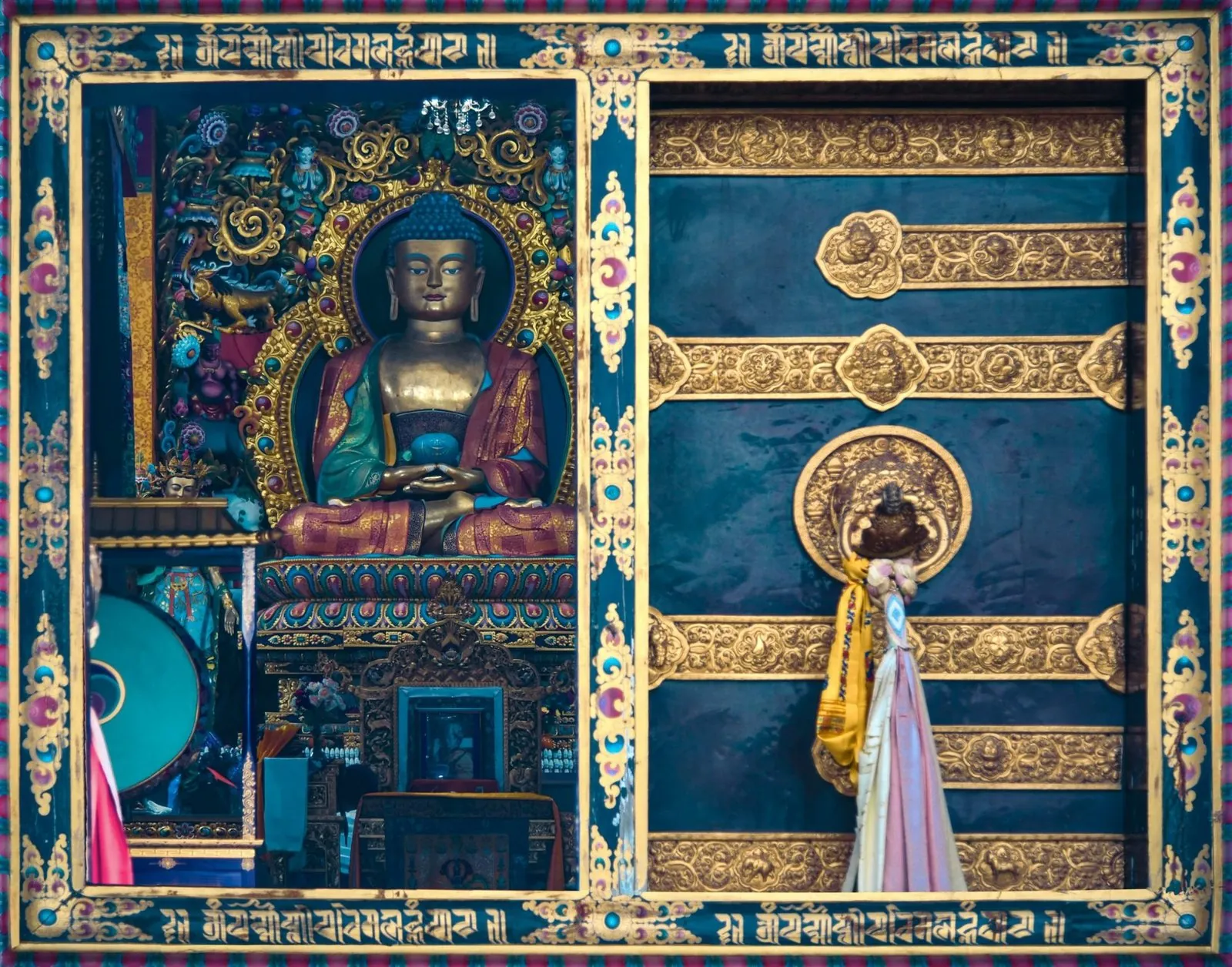
Dreams in Buddhism & Tibet: Dream Yoga, Milam & the Sleep of Awakening
In Buddhist thought, dreams and waking life are equally illusory, both are māyā. Tibetan monks turned this insight into a practice: milam, dream yoga, a technology of lucid dreaming developed 1,000 years before Western science proved it was real.
Buddhist dream yoga, called milam in Tibetan, is the practice of becoming aware you are dreaming while you sleep, then working with the dream to see how the mind creates its own experience. Its aim is to train that same lucid awareness for the process of dying, so a practitioner can stay conscious through death and toward liberation.
At a glance
- Milam (rmi lam, "dream path") is one of the Six Yogas of Nāropa, tantric practices dating to the 11th century.
- The practice moves through four stages: recognizing the dream, transforming it, seeing appearances as empty projections, and dissolving imagery into the Clear Light (ösel).
- Its purpose is preparation for death: if you can stay lucid in a dream, tradition holds you may stay lucid in death and choose your next rebirth or reach liberation.
How to read this
This is a respectful account of a living Buddhist practice, not a claim that dream yoga produces the outcomes tradition assigns to it, such as choosing a rebirth. It describes what practitioners aim for, from recognizing a dream to resting in the Clear Light. Milam belongs to the Six Yogas of Nāropa and is traditionally passed from a teacher to a student, not learned from a summary like this one.
Five Great Dreams Before Enlightenment
According to the Pāli Canon, Siddhartha Gautama experienced five momentous dreams on the night before his Great Awakening, prophetic confirmations of his imminent enlightenment. The great earth was his bed and the Himalayas his pillow. A grass stalk grew from his navel to the clouds. White worms with black heads crawled up his legs. Four birds of different colors became white. He walked atop filth without being soiled.
Buddhist tradition also holds that Queen Māyā, the Buddha's mother, dreamed a white elephant entered her side, interpreted as the conception of a being who would become either a universal monarch or a fully enlightened Buddha.
Milam: The Art of Lucid Sleep
Milam (rmi lam, "dream path") is one of the Six Yogas of Nāropa, advanced tantric practices from the 11th century. It is a sophisticated technology of lucid dreaming, developed roughly 1,000 years before Western science proved it real.
Stage 1: Recognize
Become aware you are dreaming. Use "reality checks" throughout the day.
Stage 2: Transform
Alter dream content, multiply objects, fly. Demonstrates the mind's creative power.
Stage 3: See Through
Realize dream appearances are projections, empty of inherent existence.
Stage 4: Dissolve
All imagery dissolves. Rest in the luminous nature of mind, Clear Light (ösel).
The purpose is preparation for death. If you can remain lucid in a dream, you may remain lucid in death, and choose your next rebirth or achieve liberation.
The Bardo Thodol: When Dying Mirrors Dreaming
The Bardo Thödol ("Liberation Through Hearing in the Intermediate State") describes the after-death experience as dream-like visions. The bardo of dreaming is the training ground. The bardo of dying is the dissolution at death. The bardo of dharmata presents visions of deities, pure projections of mind.
All the visions in the bardo are your own mind's projections, just like dreams. Recognize them, and you are free.
Core teaching of the Bardo ThödolTibet's Greatest Dreamer
Milarepa (1052-1135 CE), Tibet's most beloved yogi and poet, left a striking record of spiritual dreams. In one famous passage, he dreams of plowing a field, his guru Marpa interprets each detail as metaphor for his future teaching. His songs blur the line between meditation, dreams, and poetry, all windows into the nature of mind.
From Milam to the Stanford Sleep Lab
When Stephen LaBerge showed at Stanford in 1978 that a dreamer can signal out of a dream with deliberate eye movements, he made lucid dreaming measurable. Tibetan practitioners had been working inside their dreams for a millennium by then. Nothing in milam was aimed at laboratory proof, and the practice reaches well past the moment of recognition a lab can see. The Dalai Lama has participated in collaborative research with neuroscientists studying meditators' sleeping brains.
Facts That Will Surprise You
Did you know Tibetan monks were working inside their dreams 1,000 years before a sleep lab measured it? Recognizing a dream from within is the first stage of dream yoga (milam), and it is the part LaBerge later measured. The practice goes on from there.
Did you know monks consider lucid dreaming preparation for death? Death is the "ultimate dream", if you can recognize a dream from within, you may recognize death and achieve liberation.
Did you know the Buddha's mother dreamed of a white elephant? This conception dream was interpreted as the arrival of a being destined for supreme enlightenment.
Dreams in Buddhism & Tibet: Questions People Ask
What is Tibetan dream yoga (milam)?
Milam, meaning dream path, is a Tibetan Buddhist practice of becoming lucid inside a dream and then working with it to see the mind's projecting nature. It is one of the Six Yogas of Naropa, tantric practices dating to the 11th century.
What is the purpose of Buddhist dream yoga?
The purpose is preparation for death. Tradition holds that if you can stay aware you are dreaming, you may stay aware during the dissolution at death, and from that lucidity choose your next rebirth or reach liberation.
What are the stages of dream yoga?
Dream yoga moves through four stages: recognizing that you are dreaming, transforming the dream to show the mind's creative power, seeing dream appearances as empty projections, and dissolving all imagery into the luminous Clear Light, called osel in Tibetan.
Go Deeper
Stanford proof of conscious awareness during dreams via eye-signal experiments.
View in Sources ↗Sacred space, initiation rituals, and cyclical time, the religious dimension of dreams.
View in Sources ↗The monomyth, the universal hero's journey structure found across all dream traditions.
View in Sources ↗Explore More Traditions
One dream is a night.
Kept together, they begin to show a thread. The Dream Journal letter arrives on the 1st and the 15th: one symbol read closely, one honest idea from the science of sleep.
Free · Twice a month max · One-click unsubscribe
And if you want to keep the dreams themselves: the Companion plan keeps what you cannot see alone.
What does your dreaming mind know?
Tibetan dream yoga treats the dream as a place to practise. If you want to look at a dream of your own with the same patience, you can bring it here.
Read Your DreamNo account needed · Room for the whole dream · Private by design