Etruscan Dream Divination, and What the Record Actually Shows
Before Rome, the Etruscans were the diviners that Rome deferred to, and the Romans called their sacred books the Disciplina Etrusca. They read livers, they read lightning, and they read the signs that told a city where to set its boundaries. Dream interpretation is not among the practices the record preserves. This page sets out what the sources support and where the popular Etruscan dream tradition actually comes from.
Etruscan dream divination is not documented in any surviving source. Etruscan divination as the Roman authors transmit it has three branches, the reading of entrails, the reading of lightning, and the rites and signs of the libri rituales, and dreams appear in none of them. The dream material that circulates under an Etruscan name comes from Greek and Roman writing.
At a glance
- The Disciplina Etrusca has three branches in the Roman sources, the libri haruspicini (entrails), the libri fulgurales (lightning) and the libri rituales (rites, boundaries and signs).
- The haruspex read livers and lightning. No surviving source shows one interpreting a dream.
- Sorting dreams by source, timing and clarity is Greek and Roman taxonomy, and it reached the Middle Ages through Macrobius.
How to read this
The Etruscans left no literature of their own, so almost everything here comes from Greek and Roman authors writing about them from outside, from inscriptions, and from tomb painting that scholars can only partly read. Take this as a worldview reconstructed from limited and second-hand evidence, not a claim that dreams carry omens. Where a popular claim has no source behind it we say so rather than repeat it, and where a story shades into legend, like the boy Tages rising from a ploughed furrow to dictate the sacred books, we treat it as the myth it is.
The Disciplina Etrusca Has Three Branches
The Disciplina Etrusca was the body of sacred knowledge that governed Etruscan religious life, and the Roman sources that describe it divide it into three branches. The libri haruspicini covered the reading of entrails, above all the liver. The libri fulgurales covered lightning, which quarter of the sky it came from and what it announced. The libri rituales covered rites, the founding and bounding of cities and fields, the fate of peoples and the ordering of the underworld.
Dreams are not one of those branches. The claim that dream interpretation stood beside entrails, birds and lightning as a fourth Etruscan art is repeated in a great many places and has nothing in the surviving record behind it. What survives is the bronze liver from Piacenza with its forty-two inscribed sections, the Brontoscopic Calendar of thunder omens, and the Greek and Roman authors who described Etruscan practice from outside. None of them deals with dreams.
What the Tombs Show, and What They Do Not
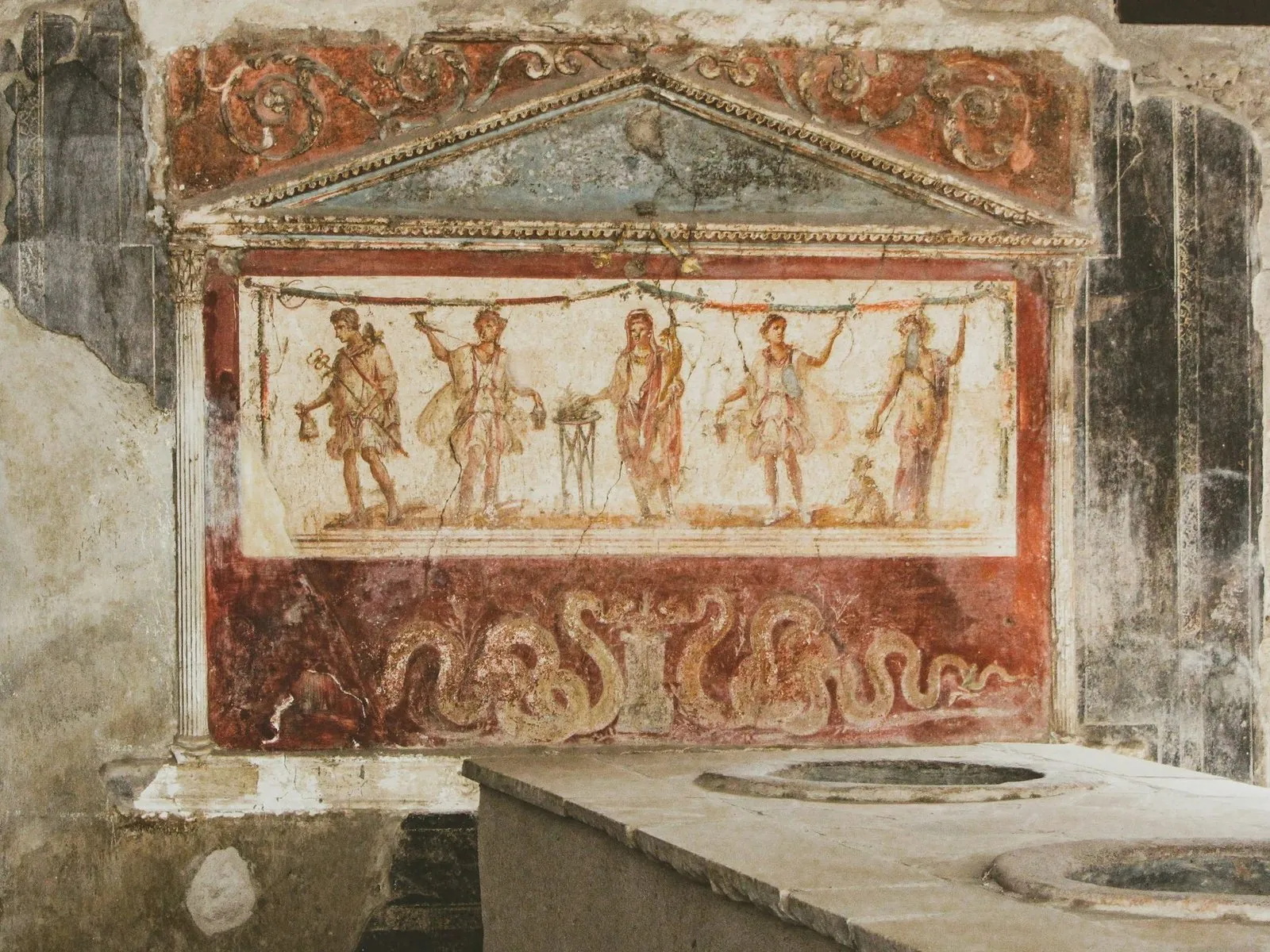
The Etruscans left painted tombs rather than texts. The frescoes in the necropolises at Tarquinia, Cerveteri and Vulci show banquets, processions, journeys to the underworld, and encounters with demons and divine beings. The Tomb of the Augurs at Tarquinia has a painted false door, a passage between the world of the living and the world of the dead, and that door recurs across Etruscan tomb art.
Reading it as a dream portal, the threshold a soul crosses in sleep, is a modern gloss with nothing in the tombs behind it. The frescoes tell us what the Etruscans expected after death. What they thought about the night before is not recorded anywhere.
What the Haruspex Actually Read
The haruspex was the Etruscan priest-diviner, trained to read the liver of a sacrificed animal and to interpret lightning. The training was hereditary and long, passed down within particular families, and the office outlived Etruscan independence by centuries. Rome kept the haruspices, consulted them on prodigies, and had them advising magistrates and generals into the Christian era.
What Rome adopted was liver reading and lightning lore. No surviving source shows a haruspex interpreting a dream, and the phrase priest-dreamer, which turns up in popular accounts of Etruria, has nothing behind it. Tages and Vegoia, the two figures the Etruscans credited with dictating the sacred books, appear in the legends as apparitions in waking life rather than as dreamers or readers of dreams.
The Roman Scheme, and One Passage Worth Naming
The scheme usually presented as Etruscan is Greek and Roman. Artemidorus set out his categories around 200 CE, Macrobius set out five kinds of dream (insomnium, visum, oraculum, somnium, visio) in his Commentary on the Dream of Scipio in the fifth century, and it was Macrobius that medieval Europe read. Sorting dreams by source, by timing and by clarity belongs to that line of writing.
One passage comes close enough to be worth naming. In the Brontoscopic Calendar, Jean MacIntosh Turfa translates a phrase as visions of the faces of gods, where another scholar proposed divine dreams for the same Greek. The text reaches us through John the Lydian, writing in Byzantine Greek, transmitting a Latin translation made by Nigidius Figulus from an Etruscan original that is lost. A conjecture at that distance does not establish an Etruscan dream practice. It is also the closest the record comes.
Facts That Will Surprise You
Did you know the Etruscan sacred books have three branches, not four? The Roman sources divide the Disciplina Etrusca into entrails, lightning, and rites and signs. Dream interpretation is not one of them.
Did you know the Piacenza liver carries forty-two inscriptions? The bronze model of a sheep's liver maps regions of the sky onto the organ and names the gods of each one. It is the richest single object we have from Etruscan divination, and nothing on it concerns dreams.
Did you know Rome kept the Etruscan diviners for centuries? The haruspices went on advising Roman magistrates and generals into the Christian era, reading livers and lightning. Their dream readings are a later addition to the story.
Etruscan Dream Divination: Questions People Ask
What was Etruscan dream divination?
Etruscan dream divination is not documented in any surviving source. Etruscan divination as the Roman authors transmit it has three branches, the reading of entrails, the reading of lightning, and the rites and signs of the libri rituales. Dreams appear in none of them, and the dream material that circulates under an Etruscan name comes from Greek and Roman writing.
What did the Etruscan haruspices read?
Haruspices read the liver of a sacrificed animal and interpreted lightning. The bronze liver from Piacenza, marked out in forty-two inscribed sections naming the gods of each region of the sky, shows how the reading was organised. Rome kept the office after conquering Etruria and consulted haruspices on prodigies for centuries.
Did the Etruscans influence Roman dream interpretation?
Rome took liver reading and lightning lore from Etruria, and there is no evidence it took anything about dreams. The Roman scheme for sorting dreams by source, timing and clarity comes from Greek writing, above all Artemidorus, and it reached the Middle Ages through Macrobius and his Commentary on the Dream of Scipio.
Go Deeper
How ancient Greeks understood dreams, ecstasy, and divine madness.
View in Sources ↗The only complete dream manual from antiquity. First to argue meaning depends on the dreamer's identity.
View in Sources ↗The authoritative cross-cultural symbol reference, every dream image mapped.
View in Sources ↗One dream is a night.
Kept together, they begin to show a thread. The Dream Journal letter arrives on the 1st and the 15th: one symbol read closely, one honest idea from the science of sleep.
Free · Twice a month max · One-click unsubscribe
And if you want to keep the dreams themselves: the Companion plan keeps what you cannot see alone.
Would the Etruscans have trusted your dream?
The Etruscans sorted dreams by where they came from and how far to trust them. Nobody can sort yours that way now, and the reading will not try. It can read the dream with you as one story.
Read Your DreamNo account needed · Room for the whole dream · Private by design