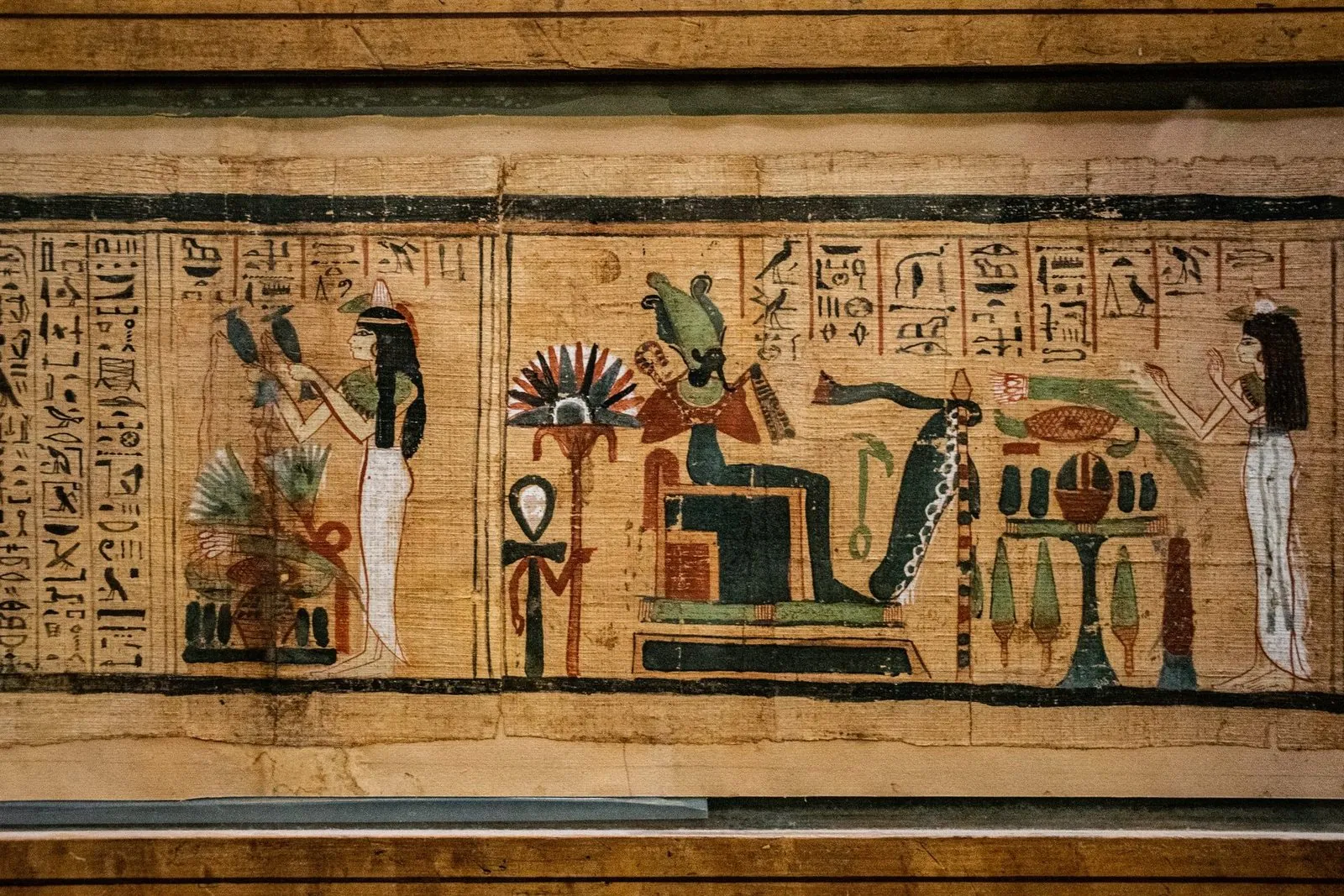
Ancient Egyptian papyrus with hieroglyphs – where dreams were divine messages from the gods
𓂀
𓂀 Dream Tradition · North Africa
c. 3100 BCE – 30 BCE · Nile Valley

Dreams in Ancient Egypt – 3,000 Years of Divine Sleep

Egyptians believed sleep was a "little death" – the soul leaving the body to travel between worlds. They built dream hospitals in temples, wrote the oldest dream dictionary on papyrus, and a single dream at the foot of the Sphinx changed the line of pharaohs.

Cosmology of sleep

When the Soul Left the Body Each Night

Egyptians believed that dreams were a gateway to Duat – the underworld and realm of the gods. Sleep was a "little death" in which the soul (Ba) left the body and traveled between worlds. Every night was a journey; every morning, a small resurrection.

The hieroglyph for "dream" (rswt) depicts an open eye – a profound paradox: in sleep, a different kind of vision opens. The Egyptians understood what neuroscience confirmed millennia later – that the dreaming brain is extraordinarily active, not passive.

This was not folk belief but state religion. Dreams were considered divine communiqués, and pharaohs employed professional dream interpreters – priests known as "Masters of Secret Things" (wab seshta) – whose interpretations could shape military campaigns, temple construction, and succession.

"The hieroglyph for 'dream' shows an open eye – in sleep, a different kind of vision begins."

– On the Egyptian understanding of dreaming
Dream temples

Dream Hospitals – 3,000 Years Before Psychotherapy

In temples at Dendera, Deir el-Bahri, and Memphis, special "dream chambers" (sekhmet chambers) existed where patients came to receive healing through sleep. The ritual preparation involved fasting, bathing, burning incense, and prayers. Priest-interpreters conducted morning sessions – essentially the world's first therapeutic dream analysis.

The Greek temple incubation at Epidaurus (160 beds!) was directly modeled on this Egyptian practice. The concept traveled from the Nile to the Mediterranean and eventually influenced Roman dream culture.

Key Dream Deities

𓂀

Serapis

Greco-Egyptian god of healing dreams. His temple in Alexandria drew dream-seekers from across the ancient world.

Bes

Protective deity whose image was placed under headrests to guard against nightmares and evil spirits during sleep.

Tutu

God-demon who served as guardian against nightmares – the bouncer at the gates of sleep.

Thoth

God of wisdom, patron of scribes and dream interpreters. Knowledge itself was considered a divine dream gift.

Dream papyrus

The Oldest Dream Dictionary – 1275 BCE

The Chester Beatty Papyrus III (c. 1275 BCE) is the oldest surviving dream dictionary – over 200 dream interpretations systematically organized by theme. Dreams were classified as "good" or "bad", with practical advice for each.

Some interpretations feel timeless: dreaming of a deep well meant prosperity; dreaming of falling meant loss of status. Others reveal the Egyptian worldview: dreaming of drinking warm beer was a bad omen (suffering would come). The same symbolic logic – water, heights, consumption – appears in dream traditions from China to Greece.

What symbols appeared in your dream?

The Egyptians catalogued 200+ dream symbols. Our AI interpreter considers thousands – in your personal context.

☽ Interpret Your Dream
Key stories

Dreams That Shaped Egypt

Thutmose IV & the Dream Stela

A young prince fell asleep in the shadow of the Great Sphinx at Giza. The Sphinx (as the god Horemakhet) appeared in his dream and promised him the throne if he cleared away the sand. He fulfilled the vow and became pharaoh. The Dream Stela – still standing between the Sphinx's paws – is physical proof of a prophetic dream.

The Chester Beatty Papyrus

Over 200 dream interpretations written on papyrus – the oldest dream dictionary in human history. Systematic, practical, and surprisingly modern in its recognition that context matters.

The Serapeum at Alexandria

The temple of Serapis became one of the most famous dream incubation centers in the ancient world. Pilgrims from across the Mediterranean came to sleep in its sacred halls and receive healing dreams.

Royal Dream Interpretation

"Masters of Secret Things" (wab seshta) – priest-interpreters who served pharaohs. Their dream readings shaped military campaigns, temple construction, and the fate of kingdoms.

Timeline
c. 3100 BCE
Early dynastic period – dream interpretation already part of religious practice
c. 1401 BCE
Thutmose IV – Dream Stela at the Great Sphinx
c. 1275 BCE
Chester Beatty Papyrus – oldest dream dictionary (200+ entries)
c. 300 BCE
Serapeum – dream healing temple in Alexandria
c. 196 BCE
Rosetta Stone era – dream culture still central to Egyptian life
Did you know…

Facts That Will Surprise You

Did you know ancient Egypt had "dream hospitals"? In temples at Dendera and Memphis, patients slept in sacred chambers and priests interpreted their dreams each morning – 3,000 years before psychotherapy.

Did you know the Great Sphinx owes its rescue to a single dream? Prince Thutmose IV fell asleep in its shadow. The Sphinx promised him the throne if he freed it from sand. He did – and the Dream Stela still stands between its paws.

Did you know the Egyptian hieroglyph for "dream" depicts an open eye? In sleep, a different kind of vision opens – the Egyptians understood this millennia before neuroscience discovered REM.

Did you know the oldest dream dictionary is over 3,200 years old? The Chester Beatty Papyrus (c. 1275 BCE) contains 200+ dream interpretations – and some of its symbolic logic still appears in modern dream analysis.

Recommended reading

Go Deeper

Dictionary of SymbolsChevalier & Gheerbrant (1969)

Encyclopedic reference spanning Egyptian, Greek, Celtic, Hindu, Buddhist, Islamic, and Christian symbolism.

View in Sources ↗
The Greeks and the IrrationalE.R. Dodds (1951)

How ancient Greeks understood dreams, ecstasy, and divine madness.

View in Sources ↗
A Dictionary of SymbolsJ.E. Cirlot (1962)

The authoritative cross-cultural symbol reference – every dream image mapped.

View in Sources ↗
Related traditions

Explore Connected Traditions

What did your unconscious write last night?

The Dream Library is the map. Your dream is the territory.

☽ Interpret Your Dream – Free

No account needed · No character limit · Private by design

Last updated: · Maintained by the Somniary editorial team · Sources & References